Sichuan Mahjong · Beginner guide
How to Play Sichuan Mahjong — Blood Battle Rules, Illustrated

Sichuan mahjong, also called Blood Battle (xuezhan daodi), is the way people play in Chengdu and Chongqing: only three suits — characters, dots and bamboo, 108 tiles in all — no chow, only pung and kong. Each hand starts by swapping three tiles and declaring a void suit, and a win does not stop the hand: play goes on until only one player is left or the wall runs out. This page takes you from the tiles to the payments; read it once and you can sit down at our free Sichuan mahjong table against three computer opponents.
On this page
- What is Sichuan mahjong, and what do you need?
- Meet the 108 tiles
- Seats, the dealer and the deal
- Before play: swap three and the void suit
- Your turn: draw one, discard one
- Pung and kong (no chow)
- Ready and winning hands
- How fan and payments work
- Blood Battle special rules
- 8 tips for beginners
- Start playing
- Frequently asked questions
What is Sichuan mahjong, and what do you need?
- Four players, one seat each. Here you sit at the bottom and the other three seats are computer players (easy, normal or hard).
- 108 tiles: three suits — characters, dots and bamboo — numbered 1 to 9, four of each. No winds, no dragons, no flowers.
- No dice, chips or score sheet needed: the dice, the deal, the fan and every payment are handled for you, and the result screen lists each payment.
- A match is 1, 4 or 8 hands; one hand takes a few minutes.
Meet the 108 tiles
Each suit has 36 tiles. Once you can read the faces, you are ready:
With only three suits, and one of them given up as your void, a winning hand has at most two suits — so a pure one-suit hand is far more common than in other mahjong games. More detail in the guide chapter The tiles.
Seats, the dealer and the deal
- Choosing the dealer: in the first hand a dice roll decides the dealer. After that, the first player to win deals the next hand (if the first win was several players winning on one discard, the player who discarded deals; if nobody wins, the dealer stays).
- Breaking the wall: the dealer rolls two dice; the total decides whose wall the deal starts from.
- The deal: starting with the dealer, everyone takes 4 tiles three times, then 1 more each, and the dealer takes one extra. The dealer has 14 tiles, everyone else 13.
- Turn order is counter-clockwise: after you comes the player on your right.
Before play: swap three and the void suit
These two steps are what make Sichuan mahjong different. All four players do them at the same time.
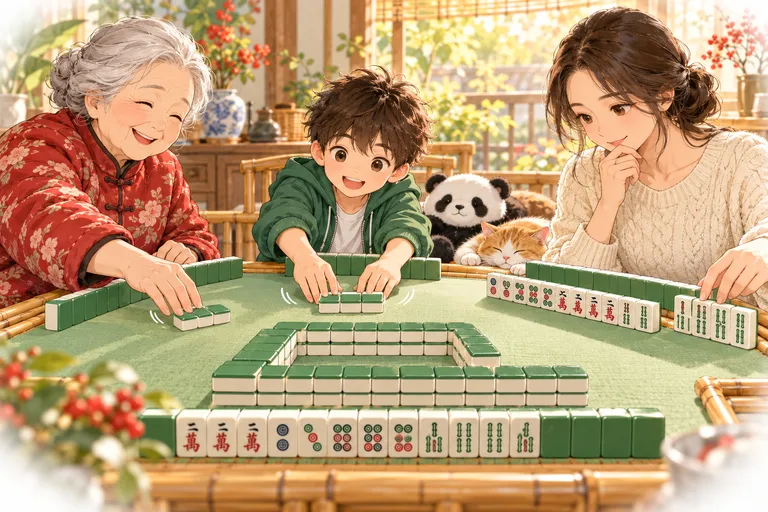
Swap three: everyone passes three tiles of the same suit. The direction comes from the dealer's opening dice roll: a total that leaves remainder 1 when divided by 3 goes to the right, remainder 2 to the left, and an exact multiple of 3 goes across. The swap happens once all four have chosen, and the three tiles you received are marked.
Void suit: after the swap, everyone declares one suit they will not keep. From then on:
- while you hold any tiles of your void suit, you must discard those first;
- you cannot pung or kong void-suit tiles;
- you cannot win while holding a void-suit tile.
Usually you swap away and declare void the suit you hold fewest of. Tips and examples in Swap three and the void suit.
Your turn: draw one, discard one

The dealer discards first (they already hold 14 tiles). After that, on each turn you:
- draw one tile from the wall, giving you 14;
- if those 14 tiles are a winning hand you may declare self-draw; with four of a kind you may declare a concealed kong;
- otherwise discard one tile, face up in front of you.
If nobody claims the discard, the player on the right draws next. While you still hold void-suit tiles, the game only lets you pick those. The full turn flow is in How a turn works.
Pung and kong (no chow)

In Sichuan mahjong you cannot chow (take the previous player's tile to make a run) — only pung and kong:
| Call | When | Then |
|---|---|---|
| Pung | Anyone discards a tile and you hold two of it | Show the three, then discard (no draw) |
| Exposed kong | Someone discards a tile and you hold three of it | Show the four, draw a replacement from the back of the wall |
| Added kong (wind) | You already punged it and draw the fourth yourself | Add it, draw a replacement; others may rob it to win |
| Concealed kong (rain) | You hold all four yourself | Lay them down, draw a replacement |
Priority: a win always beats a pung or kong; if several players can win on the same tile, they all win. After a pung or kong, play continues from the player who called it, skipping anyone in between.
A kong is paid on the spot ("wind and rain"); the amounts are in "Blood Battle special rules" below.
Ready and winning hands
The basic winning shape is four sets + one pair (14 tiles):
- Set: three identical tiles (a pung — a called one counts too) or a run of three in one suit (e.g. ); a kong counts as one set.
- Pair: two identical tiles.
- Seven pairs with no calls also wins; four identical tiles count as two pairs.
- You must not hold any void-suit tile, and the winning tile cannot be one either.

Being ready means you need one tile to win. Look at this hand (bamboo is void):
When someone discards the 8 of dots, you win:
Won on a discard
| Plain hand (平胡) | 0 fan |
| Total | 0 fan |
|---|---|
| Each payer pays 1 units | |
Units = 2 to the power of fan, up to the cap. Self-draw bonus and kong payments come on top.
Passed win: if you could win on a discard and choose not to, you cannot win on anyone's discard until your next draw (self-draw is still fine). More winning patterns in Winning.
How fan and payments work
Hands are measured in fan, and the payment is "base × 2 to the power of fan": 0 fan is 1 unit, 1 fan 2, 2 fan 4… up to the cap. The default cap here is 4 fan (16 units); settings let you choose 3 to 6.
- Win on a discard: only the discarder pays.
- Self-draw: every player who has not yet won pays, plus 1 extra unit each (self-draw bonus).
The patterns you will see most:
| Pattern | Condition | Fan |
|---|---|---|
| Plain Hand | No other pattern | 0 |
| All Pungs | All four sets are pungs or kongs | 1 |
| Pure One Suit | The whole hand is one suit | 2 |
| Seven Pairs | Seven pairs, no calls | 2 |
| Dragon Seven Pairs | Seven pairs including four of a kind | 3 |
| Root | Each kind with all four tiles in your hand or kongs | +1 each |
| Win after a kong | Self-draw on a kong replacement | +1 |
Fan add up. This hand is scored live by the same engine the game uses:
Won on a discard
| All pungs (對對胡) | 1 fan |
| Pure one suit (清一色) | 2 fan |
| Total | 3 fan |
|---|---|
| Each payer pays 8 units | |
Units = 2 to the power of fan, up to the cap. Self-draw bonus and kong payments come on top.
All 17 patterns, with examples and how each is scored, are in the Sichuan mahjong fan table; payment details are in Scoring.
Blood Battle special rules

A win does not end the hand: the winner lays the hand open and drops out, and play continues from the next player. The hand ends only when three players have won or the wall runs out — so one hand can have several winners, each paid separately.
Wind and rain: a kong is paid the moment it stands, in units, by the players who have not yet won:
- exposed kong: the discarder pays 2;
- added kong ("wind"): each player still in pays 1;
- concealed kong ("rain"): each player still in pays 2.
Kong money passed on: if the tile you discard after a kong's replacement draw lets someone win (deal-in after a kong), the money that kong collected goes to the winner.
When the wall runs out, the players still in are checked:
- Flower pig: anyone still holding void-suit tiles pays the cap to every player who is not a flower pig;
- Not ready: a player who is not ready pays each ready player the highest fan that player could win;
- Kong refund: players who are not ready give back the kong money they collected this hand.
8 tips for beginners

- Sort your hand by suit — characters, dots and bamboo apart — so the weakest suit is obvious.
- Swap three from your weakest suit: pick its three least useful tiles, and avoid breaking a pair.
- Declare void the suit you hold fewest of, then discard it straight away: you cannot win while holding it, and at the end it makes you a flower pig.
- Lots of one suit? Go for one suit: with nine or more of one suit after the swap, a Pure One Suit is often worth chasing — with only three suits it is much easier than in other mahjong.
- Lots of pairs? Think All Pungs: with four or more pairs in your starting hand, punging toward All Pungs often pays; don't force Seven Pairs — take it if it comes.
- Defend with the void suits: a tile from someone's void suit is always safe against them, and a player still discarding void tiles cannot win yet.
- Time your kongs: wind and rain pays at once, but if your discard after the kong deals in, the kong money is transferred — be careful late in the hand when others are ready.
- Be ready before the wall runs out: a player who is not ready pays the ready players and refunds their kong money.
More strategy in Strategy and defence.
Start playing
Now that you know the rules, the best way to learn is to play a few hands. Play Sichuan mahjong Blood Battle online with no download and no sign-up: choose a single hand, turn on the ready hints and follow the prompts to swap, declare your void, pung, kong and win. Or go straight to the table.
Frequently asked questions
How many tiles are in Sichuan mahjong?
108: three suits (characters, dots and bamboo), 1 to 9, four of each. There are no honour tiles (winds and dragons) and no flowers.
Can you chow in Sichuan mahjong?
No. Sichuan mahjong only allows pung and kong; you cannot take the previous player's discard to make a run. Runs must be drawn yourself.
What does "Blood Battle" mean?
A win does not end the hand: the winner drops out and the others keep playing until three players have won or the wall runs out. So one hand can have several winners.
What are the void suit and the flower pig?
At the start of each hand every player declares one suit they will not keep. Those tiles must be discarded first, cannot be punged or konged, and you cannot win while holding one. A player still holding void tiles when the wall runs out is a flower pig and pays the cap to every player who is not.
How is Sichuan mahjong scored?
A win collects base × 2 to the power of fan, up to the cap (4 fan by default here). On a discard only the discarder pays; on a self-draw every player still in pays, plus 1 extra unit each. Kongs are paid separately on the spot (wind and rain).
When does a hand end?
When three players have won (only one is left) or the wall runs out. If the wall runs out, the players still in are checked for flower pig, not ready and kong refunds.
Does it cost anything to play Sichuan mahjong here?
No. The site is completely free with no sign-up; open your browser and play against three computer opponents. Scores are in-game points only, with no real money.
Try it at the table
Sichuan Mahjong — Play Sichuan mahjong “blood battle” free in your browser against three computer opponents. 108 tiles, swap three, pick a void suit, pung and kong, and keep playing after someone wins. Automatic fan scoring, no sign-up.