Sichuan Mahjong · 0 fan
Plain Hand (Ping Hu) in Sichuan Mahjong: Fan, Examples and Odds
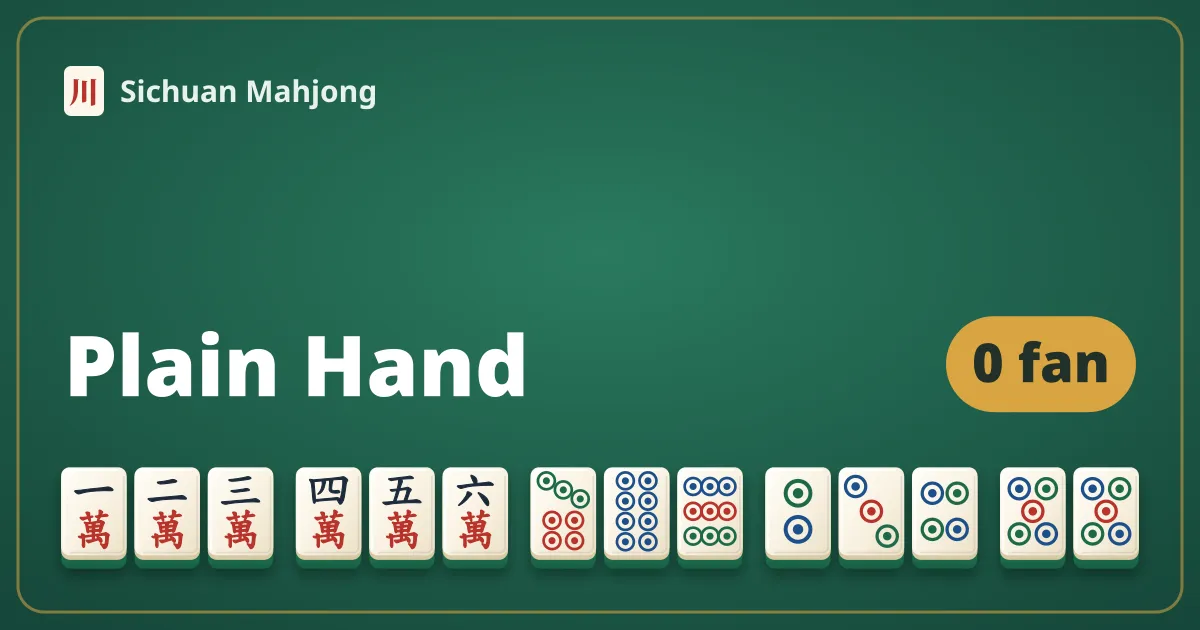
In Sichuan mahjong, the plain hand (平胡, ping hu) is worth 0 fan — each payer pays 1 unit: you won, but with no other scoring pattern at all. Zero fan means 2 to the power 0 = 1 unit; it is the most basic and by far the most common win in blood battle.
On this page
The rules for the plain hand
- A winning hand (four sets and a pair) with no scoring pattern at all; seven pairs already scores 2 fan, so it is never a plain hand
- A Sichuan plain hand can include pungs and claimed sets: as long as it isn't All Pungs, pure one suit and so on, it's plain
- One root or any situational fan (self-draw fan option, after-kong deal-in, last tile…) and it stops being listed as a plain hand
- Like every Sichuan win, you can't hold your void suit
How the plain hand waits
There's no shape restriction, so waits are as wide as they get: two-sided, closed, edge, single and two-pair waits all work. Blood battle rewards winning early: the hand goes on after others win, but the wall keeps shrinking, and a wide plain-hand wait wins sooner.
Won on a discard
| Plain hand (平胡) | 0 fan |
| Total | 0 fan |
|---|---|
| Each payer pays 1 units | |
Units = 2 to the power of fan, up to the cap. Self-draw bonus and kong payments come on top.
How the plain hand is scored
Zero fan, so each payer pays 2 to the power 0 = 1 unit. The hands below are scored live by the same code the game uses (the self-draw bonus and kong payments come on top).
Won on a discard
| Plain hand (平胡) | 0 fan |
| Total | 0 fan |
|---|---|
| Each payer pays 1 units | |
Units = 2 to the power of fan, up to the cap. Self-draw bonus and kong payments come on top.
Won on a discard
| Root (根) | 1 fan |
| Total | 1 fan |
|---|---|
| Each payer pays 2 units | |
Units = 2 to the power of fan, up to the cap. Self-draw bonus and kong payments come on top.
What a plain hand collects:
| Situation | Fan | Collected |
|---|---|---|
| Plain hand, on a discard | 0 | 1 unit from the discarder |
| Plain hand, self-drawn (default: self-draw bonus) | 0 | 2 units from each player |
| Plain hand, self-drawn (self-draw fan option) | 1 | 2 units from each player |
| Plain hand + a root | 1 | 2 units from each payer |
A self-draw is paid by every player still in the hand, so even a plain hand collects much more on a self-draw than on a discard.
How it relates to other hands
- Root: four of a kind in your hand or sets turns a plain hand into 1 fan. Sichuan plain hands often pick up a root along the way.
- Self-draw: under the default rule a self-draw adds no fan but 1 unit from each payer; with the "self-draw fan" option, a self-drawn plain hand is 1 fan.
- Pure One Suit, All Pungs: tidy a plain hand into one suit or all pungs and it becomes a 2-fan or 1-fan hand.
- Ready-hand check: at an exhaustive draw, players who aren't ready pay those who are, based on the best fan they could win — at least 1 unit.
Plain hand odds
In 40,000 hands of normal computer play, about 2.9 players win per hand, and the plain hand is 74% of all wins; across all wins the average is 0.4 fan, with each payer paying 1.5 units.
| Fan | Share of wins |
|---|---|
| 0 fan | 74% |
| 1 fan | 17% |
| 2 fan | 7.3% |
| 3 fan | 1.2% |
| 4 fan (Cap) | 0.24% |
Source: 40,000 hands of computer play on this site (four normal-level players, 115,067 wins in total), cap 4 fan.
Of the plain-hand wins, 35% were self-drawn, after 8.0 draws on average. In other words, most of blood battle is spent winning 0- and 1-fan hands; what really decides the result is the handful of pure one suits, seven pairs and capped hands.
When to take a plain hand
- Less than half the wall left: win and get out, before the ready-hand check or others' self-draws cost you.
- Two players have already won: it's just you and one other player; a plain hand from them beats a draw.
- A scattered start: no suit concentrated, few pairs — big hands are too slow, and the plain hand is the realistic goal.
- Not dealing in matters more than a big hand: a wide plain-hand wait beats forcing a big hand and feeding someone else's pure one suit.
When not to rush: with nine or more tiles of one suit after the exchange (see Pure One Suit), or five or more pairs, heading for a big hand usually pays more. To try it, open a table of online Sichuan mahjong — the computers play blood battle with you and count the fan for you.
The plain hand in other mahjong styles
Same name, completely different meaning. Elsewhere, "pinghu" is an all-runs bonus pattern:
- Taiwanese mahjong pinghu: 2 tai (all runs, no flowers, no self-draw, no single-tile wait) (Taiwanese mahjong scoring)
- Japanese mahjong "Pinfu": 1 han (concealed, all runs, two-sided wait) (Japanese mahjong yaku list)
- Hong Kong mahjong "All Chows": 1 fan (Hong Kong mahjong fan list)
- Chinese Official (Guobiao) "All Chows": 2 fan (Guobiao fan list)
FAQ
How many fan is a plain hand?
In Sichuan mahjong the plain hand is 0 fan: the discarder pays 1 unit; on a self-draw, under the default rule, each player pays 2 units.
Can a plain hand have pungs?
Yes. A Sichuan plain hand just means "no other pattern" — pungs and claimed sets are fine.
Is a plain hand with a root still a plain hand?
No. One root is 1 fan, and the settlement lists the root, not the plain hand.
Is Sichuan's plain hand the same as Taiwanese pinghu?
No. Taiwanese, Japanese and Guobiao pinghu (pinfu, all chows) is an all-runs bonus; Sichuan's plain hand is the 0-fan base win — any winning hand with no pattern.
Related hands
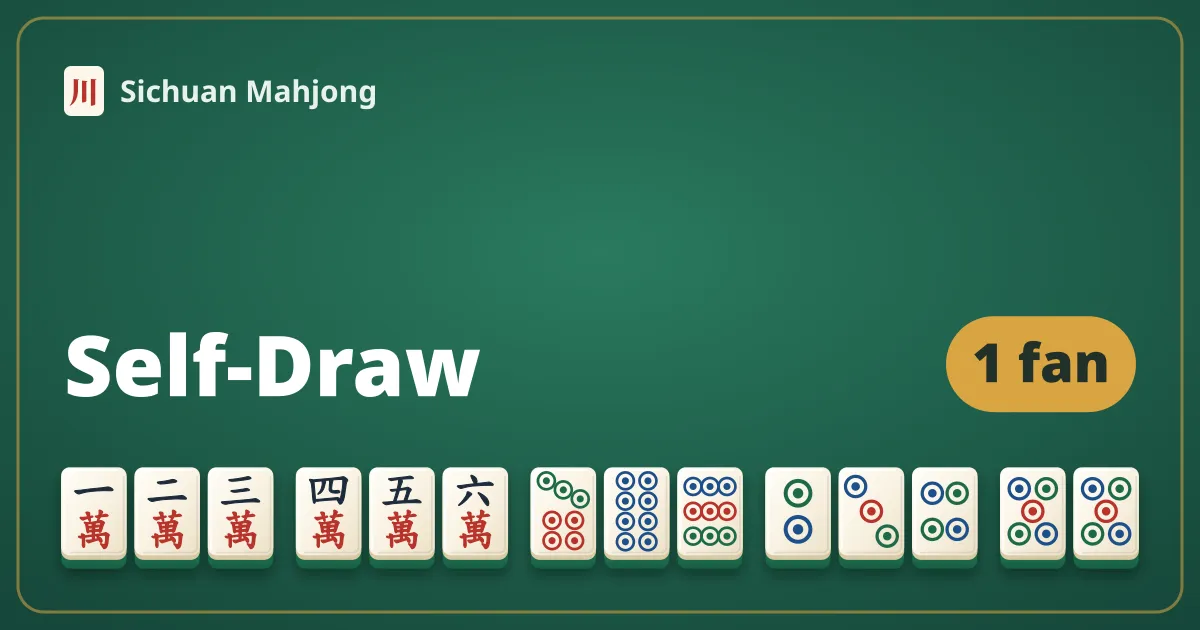 Self-Draw 1 fan
Everyone pays on a self-draw: the +1-unit bonus versus the +1-fan option, and how often wins are self-drawn.
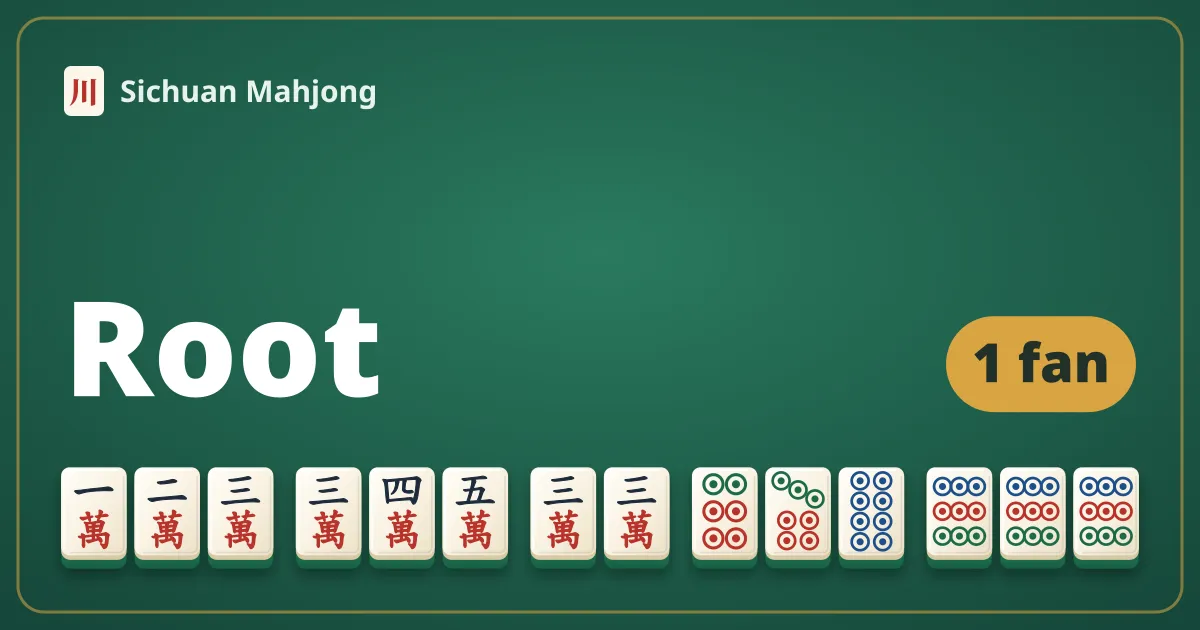 Root 1 fan
All four copies of a tile in your hand adds 1 fan: examples, no kong needed, stacking roots, and how common they are.
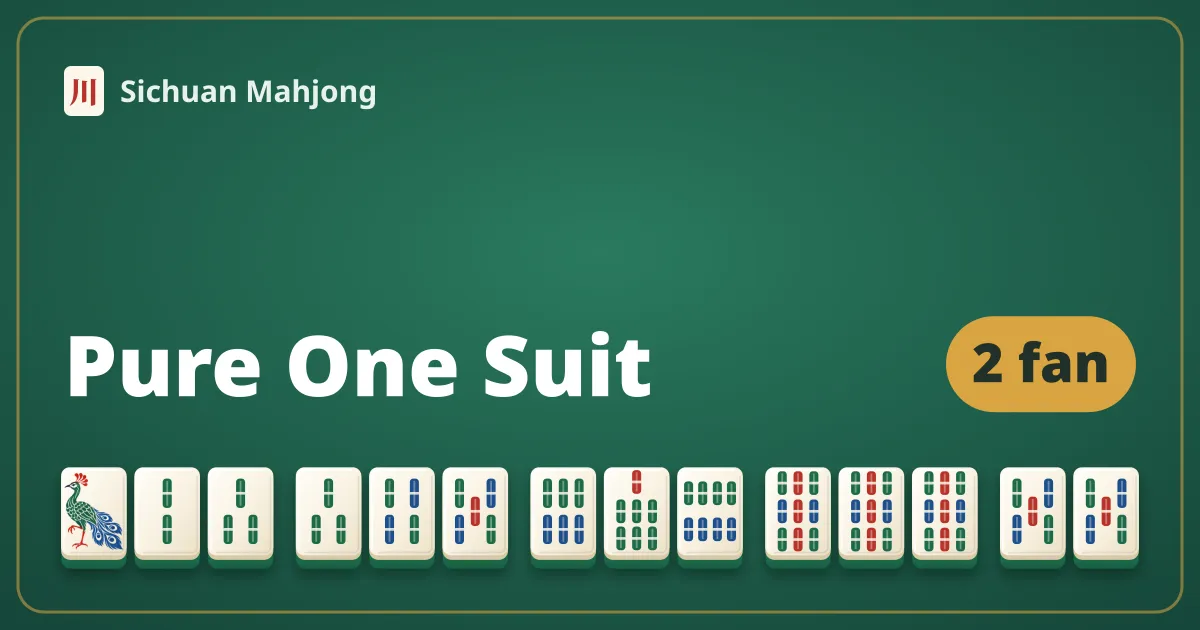 Pure One Suit 2 fan
Every tile from one suit — a 2-fan big hand. Examples, pure pungs / pure seven pairs, and how many tiles of one suit you need to go for it.
Try it at the table
Sichuan Mahjong — Play Sichuan mahjong “blood battle” free in your browser against three computer opponents. 108 tiles, swap three, pick a void suit, pung and kong, and keep playing after someone wins. Automatic fan scoring, no sign-up.