Sichuan Mahjong · 1 fan
Self-Draw (Zi Mo) in Sichuan Mahjong: Self-Draw Bonus vs Self-Draw Fan
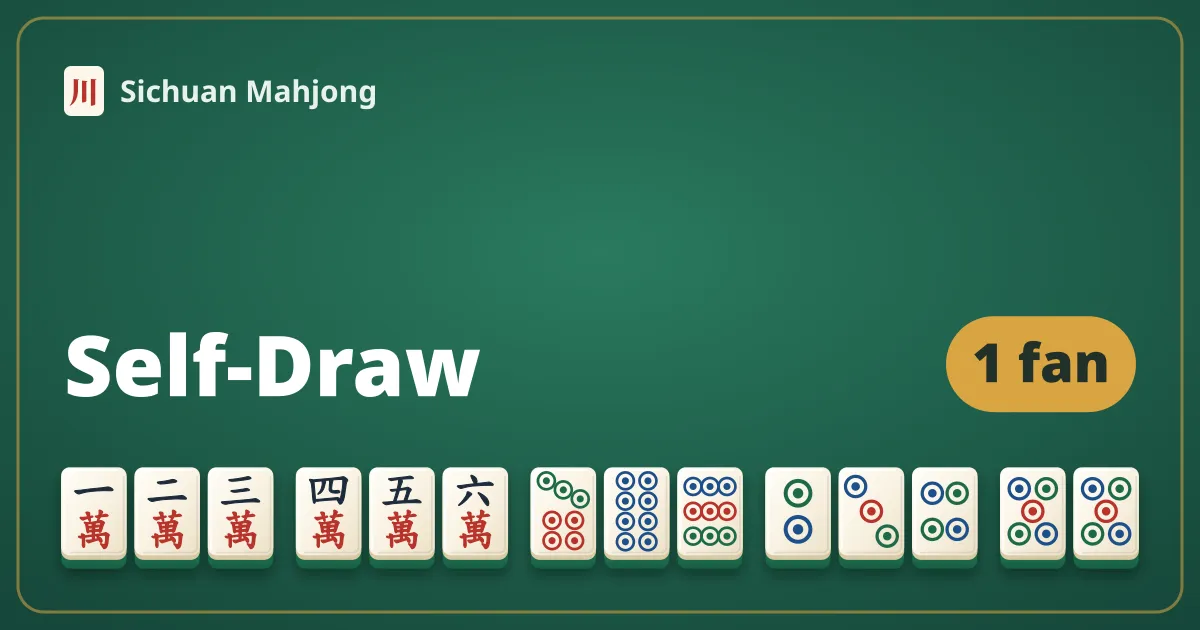
In Sichuan mahjong, a self-draw (自摸, zi mo) is paid by every player who hasn't won yet. How much extra it earns depends on the table; two rules are common:
- Self-draw bonus (this site's default, the most common in Chengdu): fan stay the same, each payer adds 1 unit
- Self-draw fan (selectable in settings): the self-draw is worth 1 fan, added to everything else, so each payment doubles
For a self-drawn plain hand the two rules happen to match: 2 units from each payer with the bonus, 2 with the fan; the more fan a hand has, the further apart they get.
On this page
The rules for self-draws
- The winning tile is one you drew yourself (including a kong replacement — that's a win after a kong)
- Winning on someone's discard means only the discarder pays; a self-draw is paid by every player still in the hand
- In blood battle, winners drop out, so a later self-draw has fewer payers: three while everyone is in, one when only one is left
- Self-draw bonus, self-draw fan or nothing — pick one; the default here is the bonus
How much the two rules differ
The same hands under each rule:
| Hand | On a discard (discarder pays) | Self-draw bonus (each pays) | Self-draw fan (each pays) |
|---|---|---|---|
| Plain hand | 1 units | 2 units | 2 units |
| One root | 2 units | 3 units | 4 units |
| Pure one suit | 4 units | 5 units | 8 units |
| Dragon seven pairs | 8 units | 9 units | 16 units |
| Pure seven pairs (already capped) | 16 units | 17 units | 16 units |
The pattern is simple:
- Plain hand: identical
- Hands with fan: the more fan, the more "one more fan" is worth — at 1 fan it's 1 unit more, at 2 fan several units more
- Hands already at the cap: the extra fan can't go past the 4-fan cap, so the bonus unit actually pays 1 more
How self-draws are scored
The hands below are scored live by the same code the game uses (kong payments come on top).
Self-drawn
| Plain hand (平胡) | 0 fan |
| Total | 0 fan |
|---|---|
| Each payer pays 1 units | |
Units = 2 to the power of fan, up to the cap. Self-draw bonus and kong payments come on top.
Self-drawn
| Self-draw bonus (自摸加番) | 1 fan |
| Total | 1 fan |
|---|---|
| Each payer pays 2 units | |
Units = 2 to the power of fan, up to the cap. Self-draw bonus and kong payments come on top.
Self-drawn
| Seven pairs (七對) | 2 fan |
| Pure one suit (清一色) | 2 fan |
| Self-draw bonus (自摸加番) | 1 fan |
| Total Capped at 4 fan | |
|---|---|
| Each payer pays 16 units | |
Units = 2 to the power of fan, up to the cap. Self-draw bonus and kong payments come on top.
How it relates to other hands
- Win after a kong: self-drawing the kong replacement is a self-draw too — everyone pays, plus the after-kong fan.
- Last-tile self-draw: self-drawing the last tile of the wall is a self-draw, plus its own fan.
- Heavenly hand, Earthly hand: both self-draws, both straight to the cap.
- Plain hand: under the default rule a self-drawn plain hand keeps 0 fan, and each player pays 2 units.
Self-draw odds
In 40,000 hands of normal computer play, 36% of all wins were self-drawn, and 35% of plain-hand wins. Scoring those self-draws under each rule: with the self-draw bonus each payer paid 2.6 units on average; with the self-draw fan, 3.1 units.
Self-draw or take the discard?
- With all three others still in, a self-draw pays best: three payers instead of one.
- With only one left: a self-draw and their discard are paid by the same player; the self-draw adds just the 1-unit bonus.
- The cost of passing: if you let a winning discard go to wait for a self-draw, you can't win on any discard until your next draw; late in the hand, take the win.
- Big waits: pure one suit or seven pairs waiting on valuable tiles make waiting for a self-draw more attractive.
To try it, open a table of online Sichuan mahjong (switch between self-draw bonus and self-draw fan in settings) — the computers play blood battle with you and count the fan for you.
Self-draw in other mahjong styles
- Taiwanese mahjong: self-draw 1 tai; concealed self-draw 3 tai (Taiwanese mahjong scoring)
- Japanese mahjong ("Menzen Tsumo"): 1 han, concealed hands only (Japanese mahjong yaku list)
- Hong Kong mahjong: self-draw 1 fan (Hong Kong mahjong fan list)
- Chinese Official (Guobiao): self-drawn 1 fan; a fully concealed self-draw is 4 fan (Guobiao fan list)
FAQ
How many fan is a self-draw in Sichuan mahjong?
It depends on the rule. With the default self-draw bonus the fan don't change and each payer adds 1 unit; with the self-draw fan option a self-draw is 1 fan.
Who pays on a self-draw?
Every player still in the hand. In blood battle, players who already won have left and don't pay.
Which pays more, the bonus or the fan?
The more fan the hand has, the more the fan option pays; but for a hand already at the cap the extra fan can't count, so the bonus pays 1 unit more.
Is a win after a kong a self-draw?
Yes. Self-drawing a kong replacement is a self-draw: everyone pays, plus the after-kong fan.
Related hands
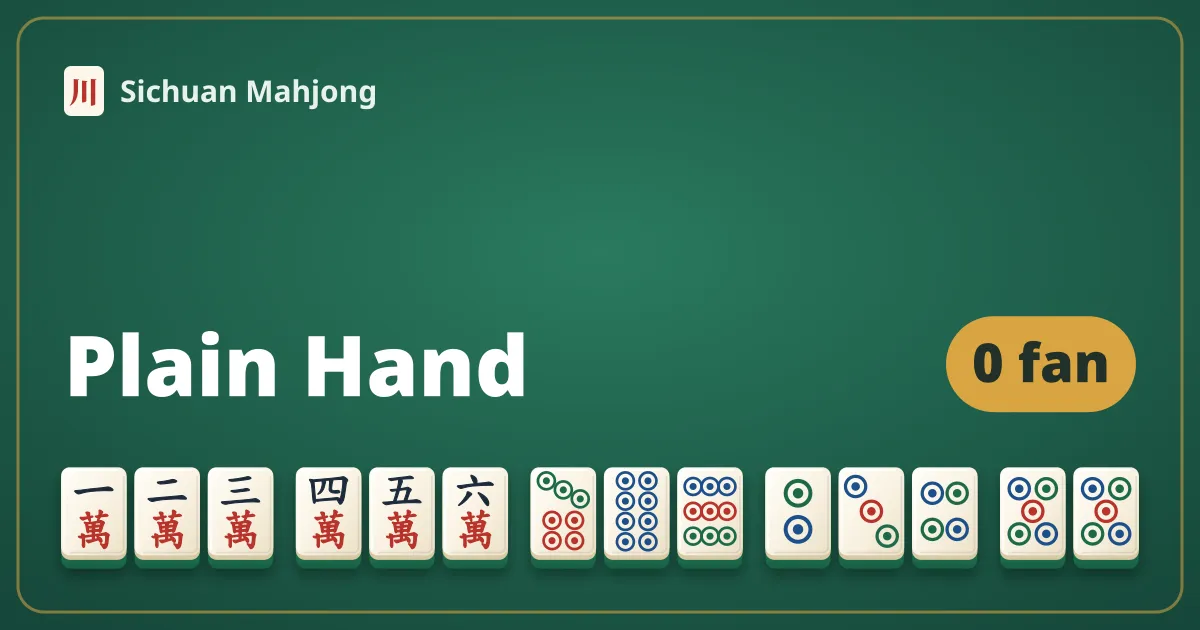 Plain Hand 0 fan
A win with nothing else — the 0-fan basic hand. Examples, pungs allowed, self-draw payments, and how common it is.
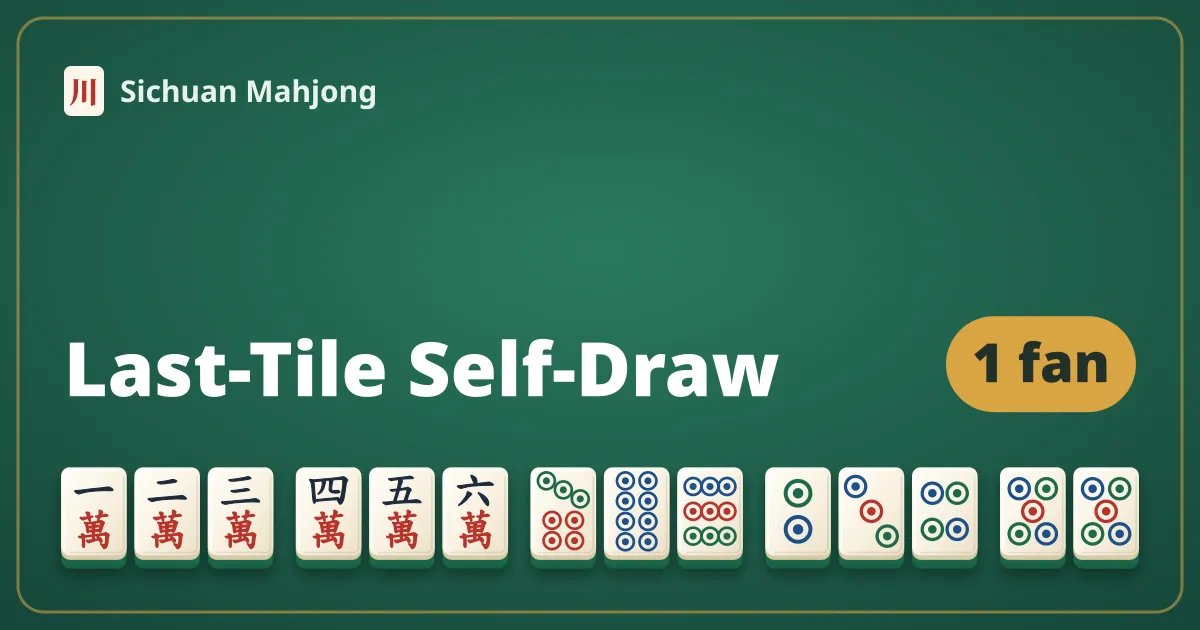 Last-Tile Self-Draw 1 fan
Self-draw the very last tile of the wall: 1 fan. Examples, the last-tile discard, and how often it happens.
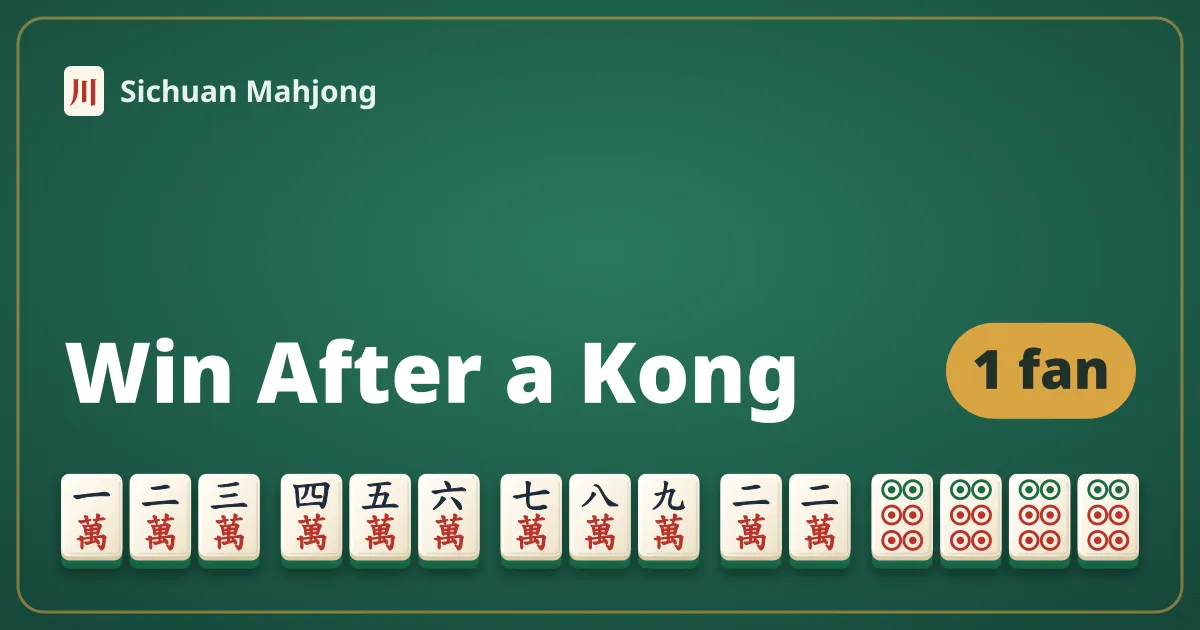 Win After a Kong 1 fan
Self-draw the kong replacement: 1 fan plus the root, at least 2 fan. Examples, who pays, and the odds per kong.
Try it at the table
Sichuan Mahjong — Play Sichuan mahjong “blood battle” free in your browser against three computer opponents. 108 tiles, swap three, pick a void suit, pung and kong, and keep playing after someone wins. Automatic fan scoring, no sign-up.