Sichuan Mahjong · 2 fan
Pure One Suit (Qing Yi Se) in Sichuan Mahjong: Fan, Examples and Odds
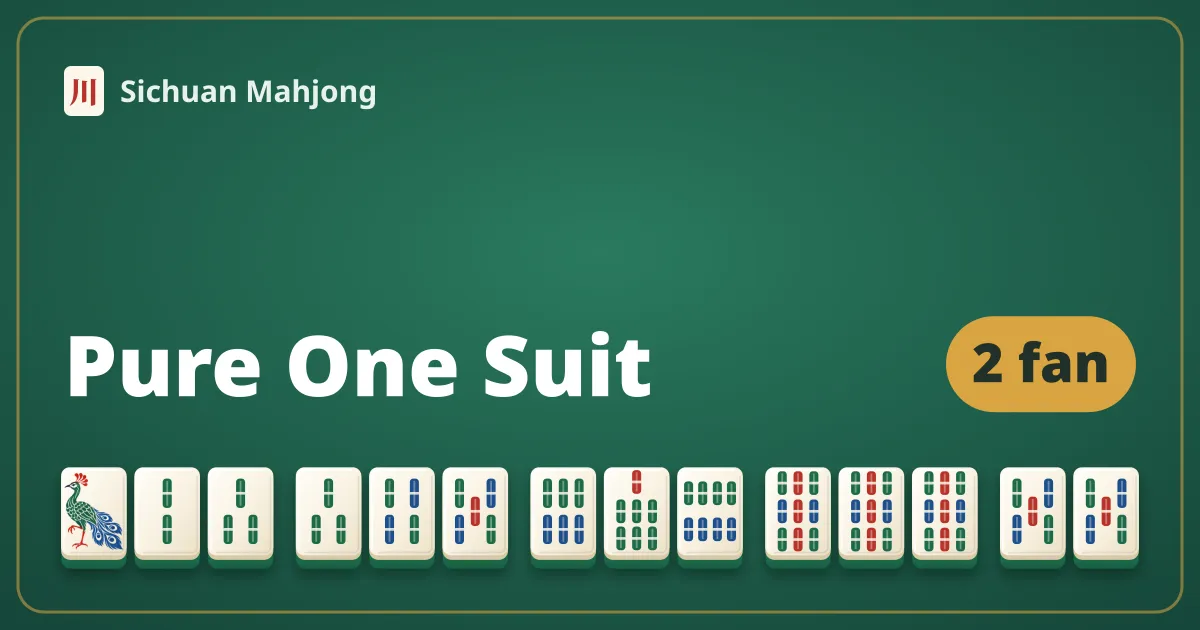
In Sichuan mahjong, Pure One Suit (清一色, qing yi se) is worth 2 fan — each payer pays 4 units: when you win, the whole hand, including punged and konged sets, is from one suit only: characters, dots or bamboo.
On this page
The rules for Pure One Suit
- All 14 tiles (plus kong extras) from one suit
- Pungs and kongs are fine — the hand doesn't need to be concealed
- Sichuan has just three suits and no honors; after declaring your void you hold two suits, so drop the other one too and it's Pure One Suit
- Plain wins, seven pairs and All Pungs can all be pure; the fan add up
Why Pure One Suit is easier in Sichuan
A Sichuan set has only 108 tiles in three suits, so one suit is a third of the wall; the three-tile exchange and the void both push your hand into two suits. Giving up one more is far easier than in Taiwanese mahjong (144 tiles, with honors), which is why Pure One Suit is the most common big hand in blood battle.
How Pure One Suit waits
Tiles of one suit connect, so a ready hand often waits on many tiles at once:
The flip side: a player going for it discards only the other suit, so everyone can read it from the discards.
How Pure One Suit is scored
Fan add up, and each extra fan doubles the payment, up to the cap of 4 fan. The hands below are scored live by the same code the game uses (the self-draw bonus and kong payments come on top).
Won on a discard
| Pure one suit (清一色) | 2 fan |
| Total | 2 fan |
|---|---|
| Each payer pays 4 units | |
Units = 2 to the power of fan, up to the cap. Self-draw bonus and kong payments come on top.
Won on a discard
| All pungs (對對胡) | 1 fan |
| Pure one suit (清一色) | 2 fan |
| Total | 3 fan |
|---|---|
| Each payer pays 8 units | |
Units = 2 to the power of fan, up to the cap. Self-draw bonus and kong payments come on top.
Won on a discard
| Seven pairs (七對) | 2 fan |
| Pure one suit (清一色) | 2 fan |
| Total | 4 fan |
|---|---|
| Each payer pays 16 units | |
Units = 2 to the power of fan, up to the cap. Self-draw bonus and kong payments come on top.
Self-drawn
| Dragon seven pairs (龍七對) | 3 fan |
| Pure one suit (清一色) | 2 fan |
| Total Capped at 4 fan | |
|---|---|
| Each payer pays 16 units | |
Units = 2 to the power of fan, up to the cap. Self-draw bonus and kong payments come on top.
Common combinations:
| Combination | Fan | Each payer pays |
|---|---|---|
| Pure One Suit | 2 | 4 units |
| Pure One Suit + root | 3 | 8 units |
| Pure pungs (+ All Pungs) | 3 | 8 units |
| Pure seven pairs (+ seven pairs) | 4 | 16 units |
| Pure dragon seven pairs (+ dragon seven pairs) | 5 | 16 units |
How it relates to other hands
- All Pungs: four pungs; with Pure One Suit it's pure pungs, 3 fan.
- Seven pairs, dragon seven pairs: seven pairs of one suit is pure seven pairs; with four of a kind it's pure dragon seven pairs — often straight to the cap.
- Root (gen): with one suit concentrated in your hand, four of a kind comes easily; each root adds 1 fan.
- Terminals in every set: every set and the pair contain a 1 or 9; stacks with Pure One Suit.
Pure One Suit odds
How many tiles of one suit you start with
In the 13-tile opening hand (before the exchange), the strongest suit has 7 or more tiles about 27% of the time, and 8 or more about 7.8%. The exchange and the void concentrate it further.
| Most tiles of one suit (as dealt) | Chance |
|---|---|
| 6+ tiles | 66% |
| 7+ tiles | 27% |
| 8+ tiles | 7.8% |
| 9+ tiles | 1.7% |
| 10+ tiles | 0.24% |
| 11+ tiles | 0.022% |
Source: 1,000,000 random 13-tile deals (before the three-tile exchange).
How often it happens in normal play
The computers on this site switch to Pure One Suit by themselves once a suit reaches ten tiles. In 40,000 hands of normal play, Pure One Suit is 1.4% of all wins; players who already had 9 or more tiles of one suit after the exchange won it 3.9% of the time.
Is it worth forcing Pure One Suit?
We let computers play on this site's table: in every hand, the player with the most tiles of one suit after the exchange had to go for Pure One Suit — void the shorter of the other two suits, discard the other one, pung only that suit, never win with anything else — while the other three played normally. Then we compared the average result with the same starts played normally.
| Most tiles of one suit (after the exchange) | Starting hands | Made it | The other three won | Wall ran out | Avg. units forcing it | Avg. units playing normally |
|---|---|---|---|---|---|---|
| 6 or fewer | 534 | 4.7% | 27% | 69% | −3.1 | −1.2 |
| 7 | 2,929 | 15% | 41% | 43% | −2.1 | −0.1 |
| 8 | 8,880 | 30% | 46% | 25% | −0.5 | +0.4 |
| 9 | 12,962 | 45% | 41% | 14% | +1.4 | +0.6 |
| 10+ tiles | 14,695 | 64% | 29% | 6.8% | +4.1 | +1.6 |
Source: computer play on this site. In each of 40,000 hands the seat with the best start (after the exchange) forced Pure one suit (清一色); the other three played normally (normal level). Result = that seat’s whole-hand units, cap 4 fan.
The opposite of Taiwanese mahjong: in Sichuan, forcing Pure One Suit pays off when your start is concentrated enough (rows highlighted above).
- With 10 or more tiles of one suit after the exchange, forcing it works 64% of the time, for an average of +4.1 units; the same starts played normally average +1.6.
- Counting 9 or more tiles together, forcing averages +2.8 units against +1.0 — still better to force.
- With 8 or fewer, don't tear your hand apart: it works less than a third of the time and does worse than normal play.
- Finished hands averaged 2.5 fan (often with roots, pure pungs or pure seven pairs) after 10.7 draws.
Why so different from Taiwan? In blood battle the hand goes on after someone wins — normal play averages 2.9 winners per hand — so someone else winning first doesn't end your chance; you only need to drop one more suit; and every fan doubles the payment. Pure One Suit has time to come together and pays well when it does.
Which hands suit Pure One Suit
- Plan before the exchange: pass three tiles from your weakest suit; if what comes back fits your main suit, you're close.
- Void your shortest suit, then pick which of the remaining two to drop.
- Tiles that connect: with the same count, adjacent tiles and pairs are easier to complete.
- Others will defend: two exposed sets of one suit and none of it in your discards tell everyone, and they'll hold that suit.
When to give up: less than half the wall is left and you still hold three or more tiles of the other suit. Watch out for the ready-hand check at an exhaustive draw: players who aren't ready pay those who are. To try it, open a table of online Sichuan mahjong — the computers play blood battle with you and count the fan for you.
Pure One Suit in other mahjong styles
Pure One Suit is a big hand everywhere, but scores differently:
- Taiwanese mahjong: 8 tai (Taiwanese mahjong Pure One Suit)
- Japanese mahjong ("Chinitsu"): 6 han concealed, 5 han open (Japanese mahjong Chinitsu)
- Hong Kong mahjong: 7 fan (Hong Kong mahjong Pure One Suit)
- Chinese Official (Guobiao, "Full Flush"): 24 fan (Guobiao Full Flush)
FAQ
How many fan is Pure One Suit?
In Sichuan mahjong Pure One Suit is worth 2 fan; each payer pays 4 units. It stacks with All Pungs, seven pairs, dragon seven pairs and roots, up to the 4-fan cap.
How many fan are pure pungs?
Pure One Suit 2 plus All Pungs 1: 3 fan, so each payer pays 8 units.
How many fan are pure seven pairs?
Pure One Suit 2 plus seven pairs 2: 4 fan, so each payer pays 16 units.
Can you pung or kong in Pure One Suit?
Yes. Sichuan Pure One Suit doesn't need a concealed hand; claimed sets just have to be the same suit.
What does the void have to do with Pure One Suit?
Your void suit can never stay in your hand, so Pure One Suit only means giving up one of the remaining two suits. Void your shortest suit and Pure One Suit gets closer.
Related hands
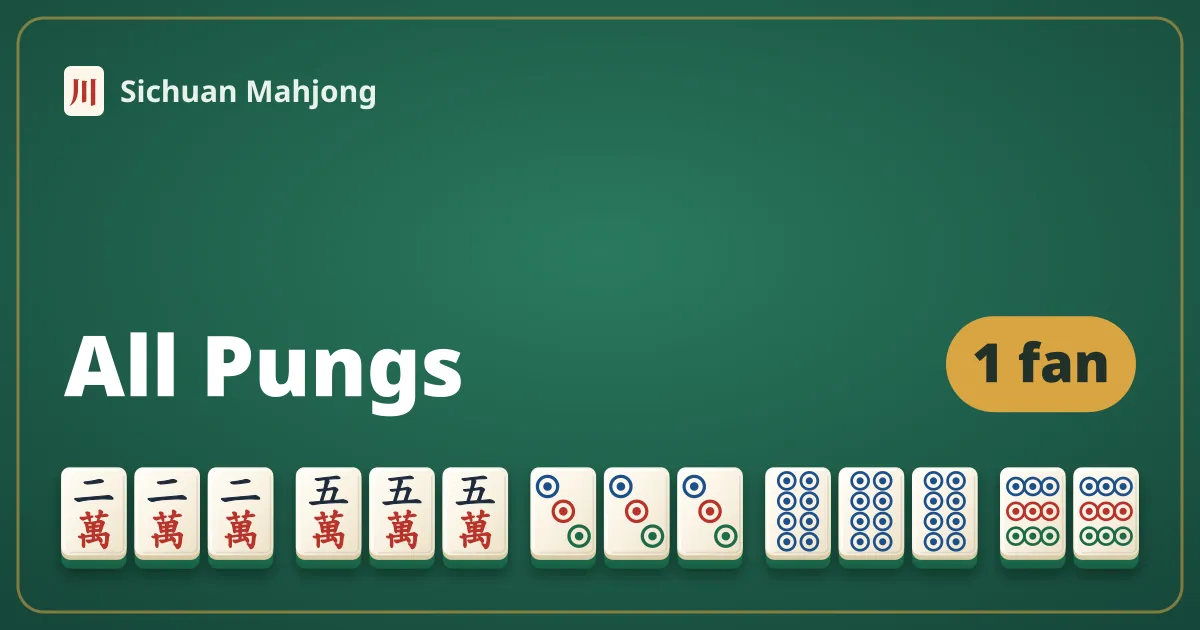 All Pungs 1 fan
Four pungs and a pair — 1 fan. Examples, 2-5-8 / golden hook / pure-pungs combos, and how many pairs you need to go for it.
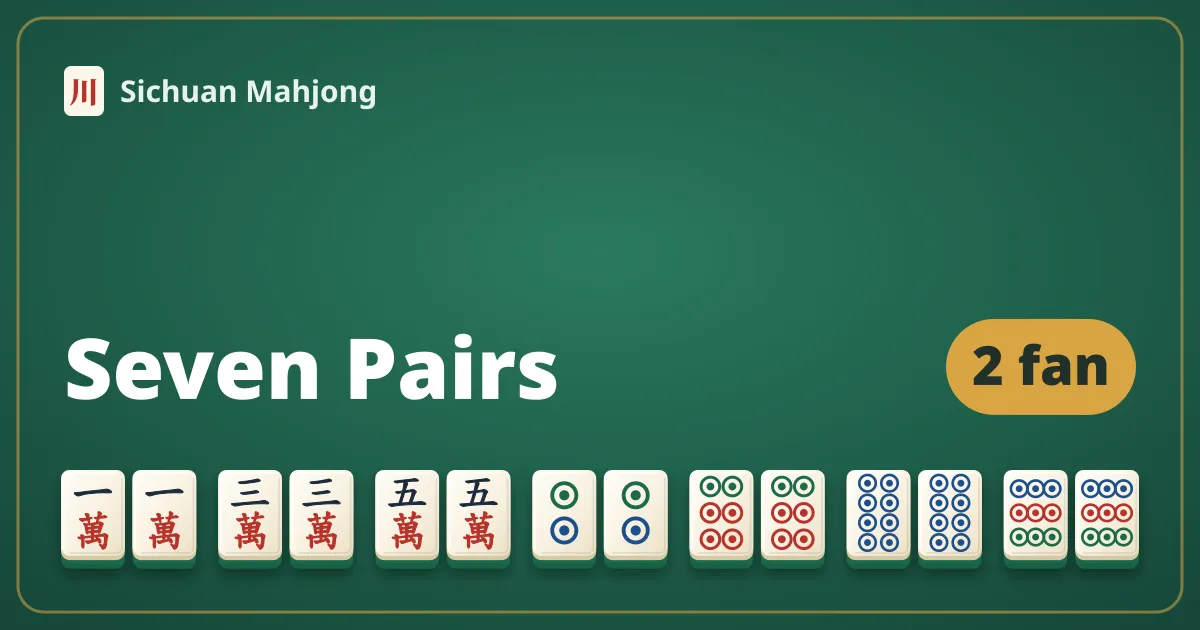 Seven Pairs 2 fan
Seven concealed pairs — 2 fan. Examples, four-of-a-kind, pure / dragon seven pairs, and how many pairs you need to go for it.
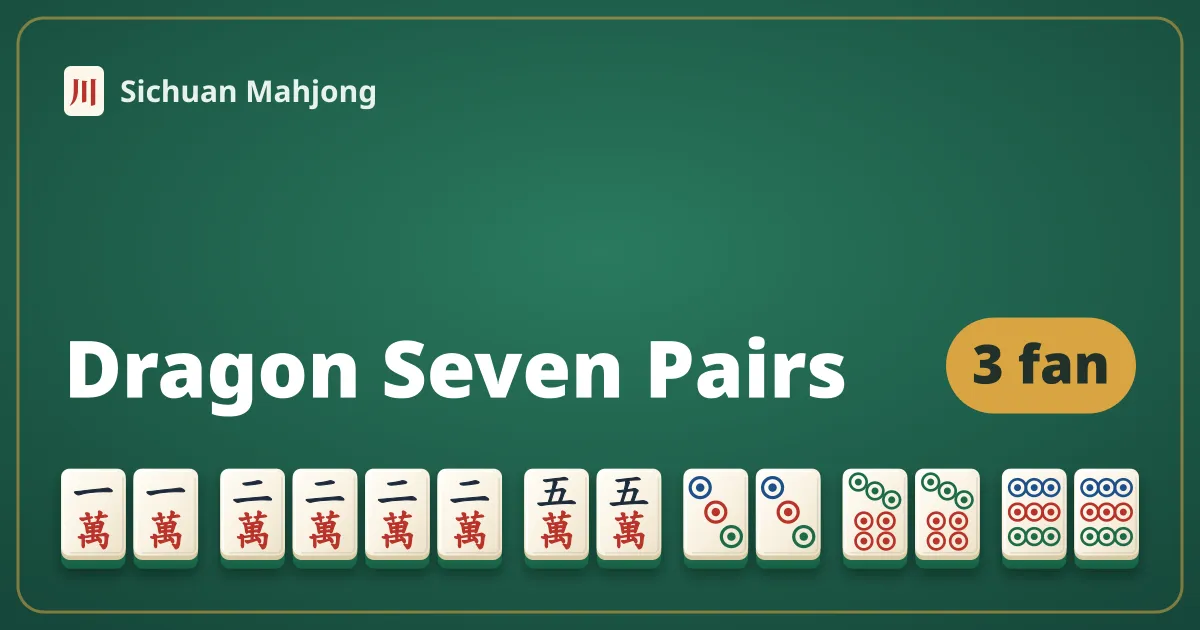 Dragon Seven Pairs 3 fan
Seven pairs with four of a kind — 3 fan. Examples, how roots work, double / pure dragon seven pairs, and how often it happens.
Try it at the table
Sichuan Mahjong — Play Sichuan mahjong “blood battle” free in your browser against three computer opponents. 108 tiles, swap three, pick a void suit, pung and kong, and keep playing after someone wins. Automatic fan scoring, no sign-up.