Sichuan Mahjong · 2 fan
Seven Pairs (Qi Dui) in Sichuan Mahjong: Fan, Examples and Odds
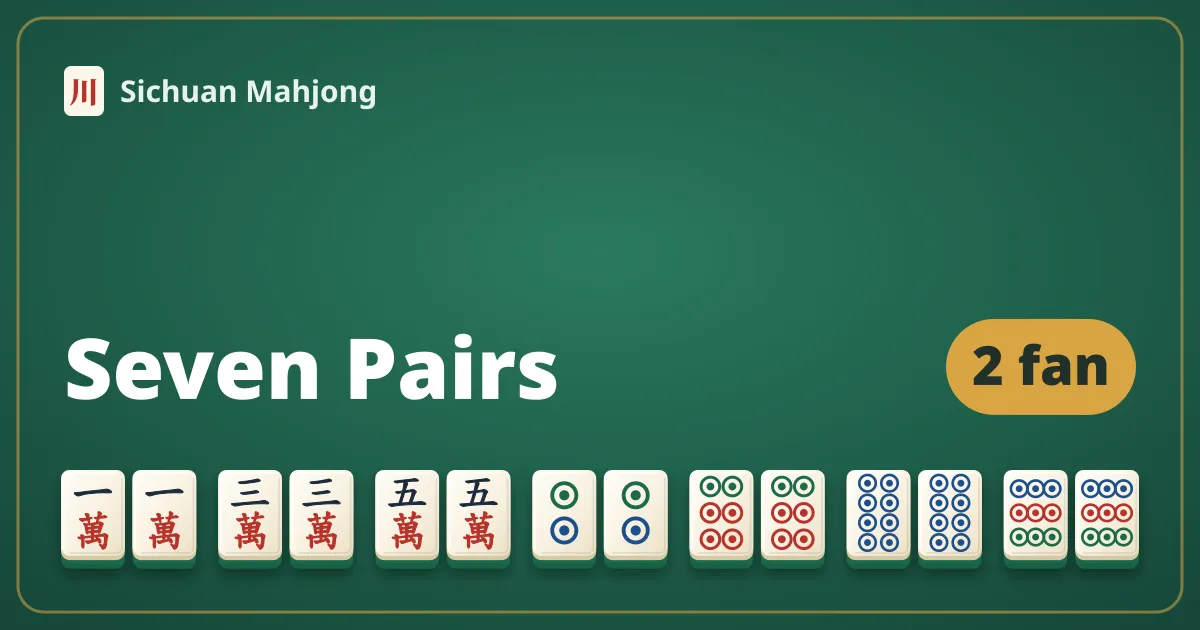
In Sichuan mahjong, Seven Pairs (七對, qi dui) is worth 2 fan — each payer pays 4 units: your 14 tiles are exactly seven pairs, and you haven't punged or konged anything. No sets needed, just pairs — it is one of the most common big hands in blood battle.
On this page
The rules for Seven Pairs
- Exactly seven pairs, fully concealed: once you pung or kong, Seven Pairs is off
- Any tiles can make the pairs — characters, dots or bamboo
- Four identical tiles count as two pairs, but then it's not plain Seven Pairs — it's Dragon Seven Pairs
- Like every Sichuan win, you can't hold your void suit, so Seven Pairs uses at most two suits
How Seven Pairs waits
Seven Pairs is always a single wait: six pairs are done and one lone tile waits for its match.
You choose which tile to wait on: every time you draw, keeping one and discarding the other changes your wait. Pick a tile nobody has discarded yet, one the others are likely to let go, or one you can still draw yourself.
When it can also be read as a normal hand, the higher score wins
Some seven-pair hands can also be split into four sets and a pair. Scoring tries both and takes the higher:
Won on a discard
| Seven pairs (七對) | 2 fan |
| Total | 2 fan |
|---|---|
| Each payer pays 4 units | |
Units = 2 to the power of fan, up to the cap. Self-draw bonus and kong payments come on top.
How Seven Pairs is scored
Fan add up, and each extra fan doubles the payment, up to the cap of 4 fan. The hands below are scored live by the same code the game uses (the self-draw bonus and kong payments come on top).
Won on a discard
| Seven pairs (七對) | 2 fan |
| Total | 2 fan |
|---|---|
| Each payer pays 4 units | |
Units = 2 to the power of fan, up to the cap. Self-draw bonus and kong payments come on top.
Won on a discard
| Seven pairs (七對) | 2 fan |
| Pure one suit (清一色) | 2 fan |
| Total | 4 fan |
|---|---|
| Each payer pays 16 units | |
Units = 2 to the power of fan, up to the cap. Self-draw bonus and kong payments come on top.
Won on a discard
| Dragon seven pairs (龍七對) | 3 fan |
| Total | 3 fan |
|---|---|
| Each payer pays 8 units | |
Units = 2 to the power of fan, up to the cap. Self-draw bonus and kong payments come on top.
Common combinations:
| Combination | Fan | Each payer pays |
|---|---|---|
| Seven Pairs | 2 | 4 units |
| Dragon Seven Pairs (with four of a kind) | 3 | 8 units |
| Pure seven pairs (+ pure one suit) | 4 | 16 units |
| Seven Pairs + deal-in after a kong | 3 | 8 units |
| Seven Pairs + last-tile self-draw | 3 | 8 units |
Seven Pairs never combines with All Pungs, golden hook or all 2-5-8 pungs (those need pungs), and it never has a root: four of a kind turns it into Dragon Seven Pairs instead.
How it relates to other hands
- Dragon Seven Pairs: Seven Pairs with four of a kind, 3 fan; only a second set of four adds a root.
- Pure One Suit: seven pairs all from one suit is pure seven pairs, 4 fan — exactly the default cap.
- All Pungs: also built from pairs, but you pung them into sets; once you pung, you can't go back to Seven Pairs.
- Self-draw, after-kong deal-in, last tile: situational fan still add, but a concealed seven-pair hand never konged, so no win after a kong.
Seven Pairs odds
How many pairs in the opening hand
In a 13-tile opening hand (before the exchange), 3 or more pairs come up about 26% of the time, 4 or more only 4.9%, and 5 or more 0.34%.
| Pairs (as dealt) | Chance |
|---|---|
| 1+ pairs | 93% |
| 2+ pairs | 65% |
| 3+ pairs | 26% |
| 4+ pairs | 4.9% |
| 5+ pairs | 0.34% |
| 6+ pairs | 0.0063% |
Source: 1,000,000 random 13-tile deals (before the three-tile exchange).
How often it happens in normal play
In 40,000 hands of normal computer play, Seven Pairs is 3.9% of all wins, and Dragon Seven Pairs another 0.45%. Seven Pairs wins average 2.0 fan, and each payer pays 4.2 units on average. Of the seats holding 5 or more pairs after the exchange, 31% went on to win with Seven Pairs (or Dragon Seven Pairs) that hand.
Is it worth forcing Seven Pairs?
We let computers play on this site's table: in every hand, the player with the most pairs after the three-tile exchange had to go for Seven Pairs — no pungs, no kongs, discard lone tiles first (the ones with fewest copies left), and never win with anything else — while the other three played normally. Then we compared the average result with the same starts played normally.
| Pairs (after the exchange) | Starting hands | Made it | The other three won | Wall ran out | Avg. units forcing it | Avg. units playing normally |
|---|---|---|---|---|---|---|
| 2 or fewer | 3,035 | 17% | 48% | 35% | −2.4 | −0.4 |
| 3 | 17,224 | 26% | 49% | 26% | −2.0 | +0.3 |
| 4 | 16,352 | 36% | 45% | 19% | −1.3 | +0.6 |
| 5+ pairs | 3,389 | 54% | 34% | 11% | +0.5 | +1.1 |
Source: computer play on this site. In each of 40,000 hands the seat with the best start (after the exchange) forced Seven pairs (七對); the other three played normally (normal level). Result = that seat’s whole-hand units, cap 4 fan.
Unlike Pure One Suit and All Pungs, forcing Seven Pairs does worse than normal play for every kind of start (no row in the table above is highlighted).
- With 5 or more pairs after the exchange, forcing works 54% of the time, for an average of +0.5 units; the same starts played normally average +1.1.
- With 4 pairs the gap is wider: −1.0 units forcing, +0.7 playing normally.
- Finished hands averaged 2.1 fan after 11.9 draws; 3.6% were Dragon Seven Pairs and 0.89% pure seven pairs.
Why? The computers on this site already consider Seven Pairs when playing normally: with enough pairs they head for it, and they think twice before a pung that would break it. Forcing only removes the fallback to a normal hand — Seven Pairs is always a single wait on one tile, and refusing every pung costs a lot of useful tiles.
Which hands suit Seven Pairs
- Many pairs, few runs: pairs that don't connect are slow for a normal hand but quick for Seven Pairs.
- Don't pung: one pung and Seven Pairs is gone. Once you commit, let your pair tiles go by.
- Keep pairs in the exchange: pass three tiles from your weakest suit and hold on to your pairs.
- Wait on a good tile: when ready, keep a tile nobody has discarded and nobody needs — someone is more likely to throw it.
When to give up: less than half the wall is left, you still need three or more pairs, and several of your pair tiles are already out. Watch out for the ready-hand check at an exhaustive draw: players who aren't ready pay those who are. To practise, open a table of online Sichuan mahjong — the computers play blood battle with you and count the fan for you.
Seven Pairs in other mahjong styles
Seven pairs is treated very differently from style to style:
- Taiwanese mahjong (16 tiles) has no seven pairs (Taiwanese mahjong scoring)
- Japanese mahjong ("Chiitoitsu"): 2 han, and four of a kind can't count as two pairs (Japanese mahjong yaku list)
- Chinese Official (Guobiao): 24 fan (Guobiao fan list)
FAQ
How many fan is Seven Pairs?
In Sichuan mahjong Seven Pairs is worth 2 fan; each payer pays 4 units. All seven pairs from one suit is pure seven pairs, 4 fan.
Can you pung with Seven Pairs?
No. Seven Pairs must be fully concealed; after a pung or kong you can only win with a normal hand (four sets and a pair).
What if Seven Pairs includes four of a kind?
Four identical tiles count as two pairs, which makes it Dragon Seven Pairs: 3 fan, and those four don't add a separate root.
How many fan are pure seven pairs?
Seven Pairs 2 plus pure one suit 2: 4 fan, so each payer pays 16 units.
Related hands
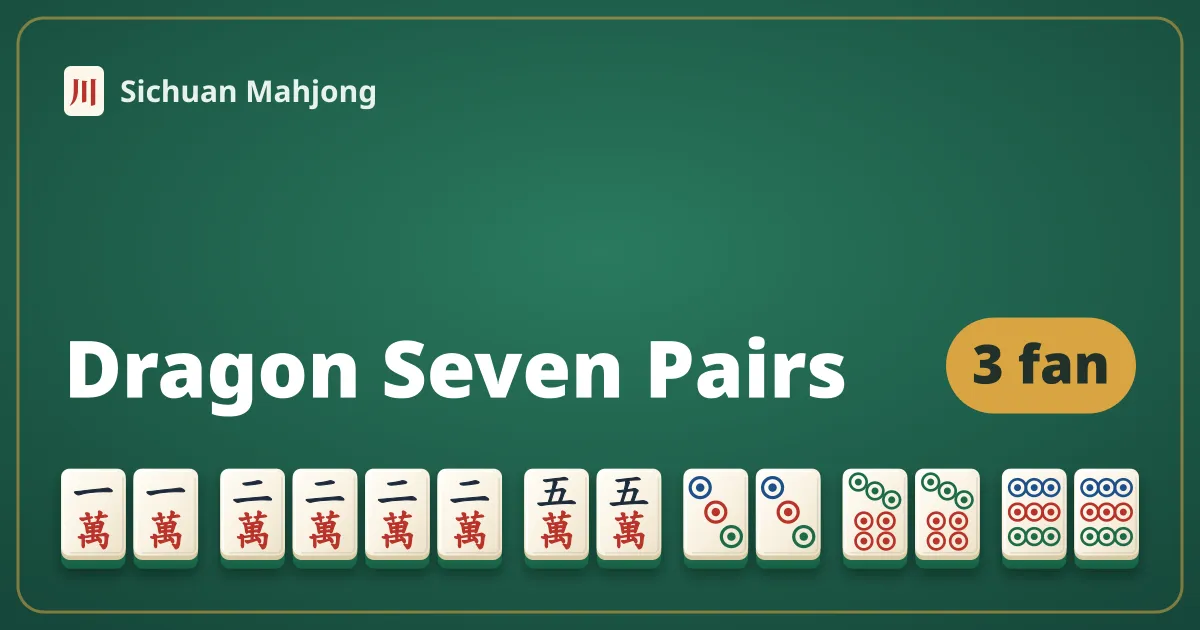 Dragon Seven Pairs 3 fan
Seven pairs with four of a kind — 3 fan. Examples, how roots work, double / pure dragon seven pairs, and how often it happens.
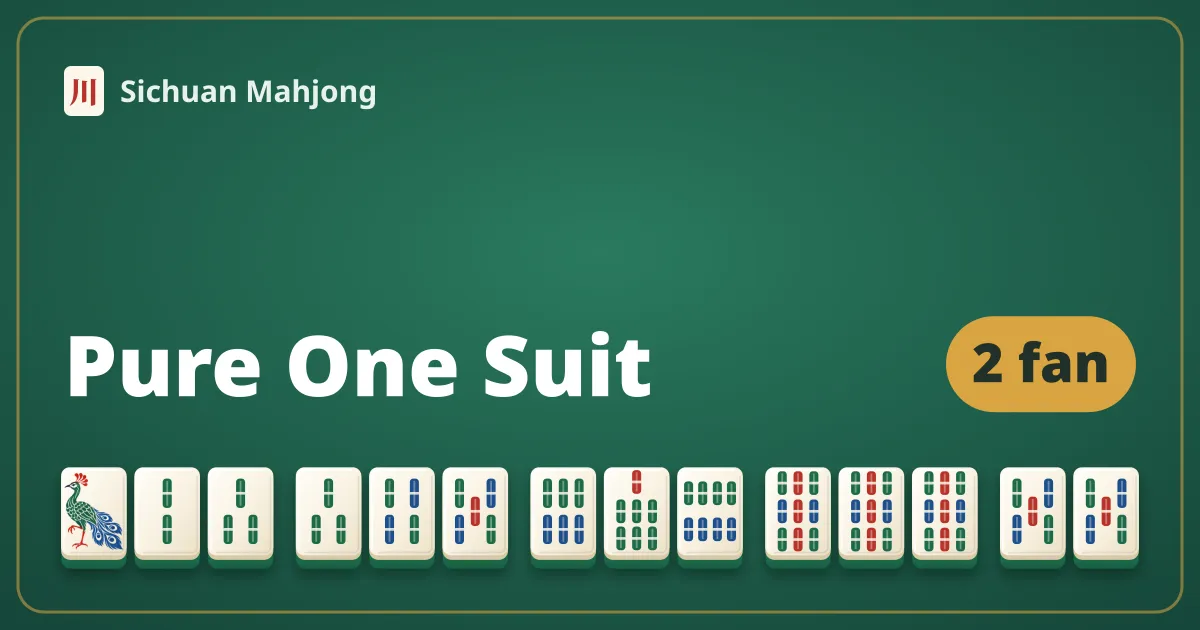 Pure One Suit 2 fan
Every tile from one suit — a 2-fan big hand. Examples, pure pungs / pure seven pairs, and how many tiles of one suit you need to go for it.
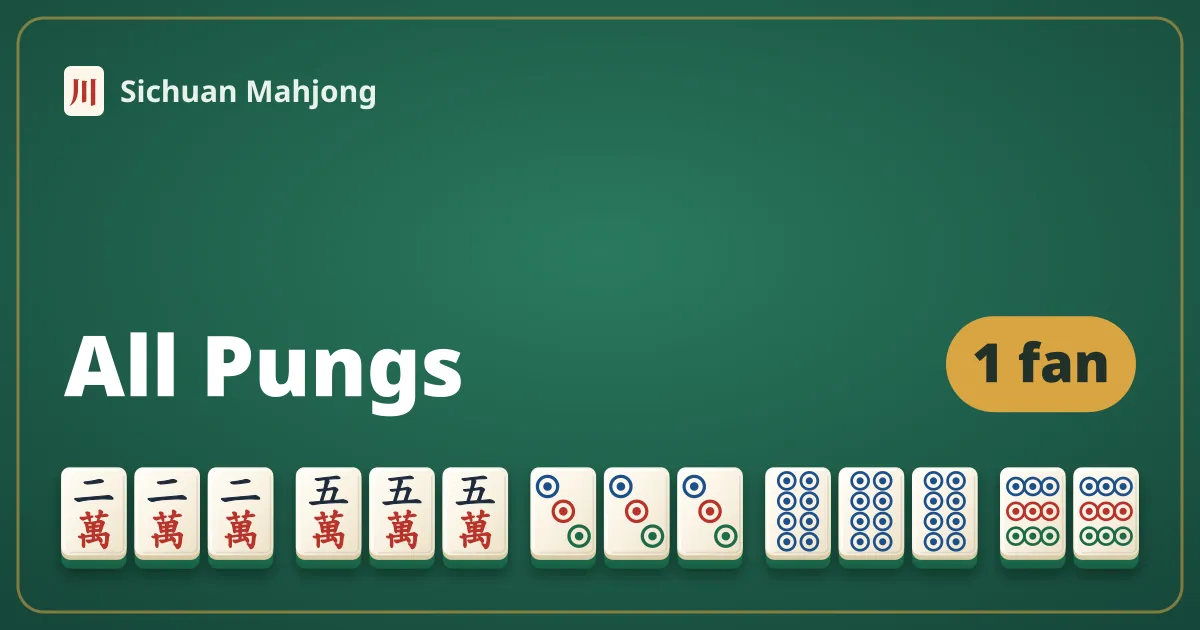 All Pungs 1 fan
Four pungs and a pair — 1 fan. Examples, 2-5-8 / golden hook / pure-pungs combos, and how many pairs you need to go for it.
Try it at the table
Sichuan Mahjong — Play Sichuan mahjong “blood battle” free in your browser against three computer opponents. 108 tiles, swap three, pick a void suit, pung and kong, and keep playing after someone wins. Automatic fan scoring, no sign-up.