Sichuan Mahjong · 2 fan
Terminals in Every Set (Quan Dai Yao) in Sichuan Mahjong: Fan, Examples and Odds
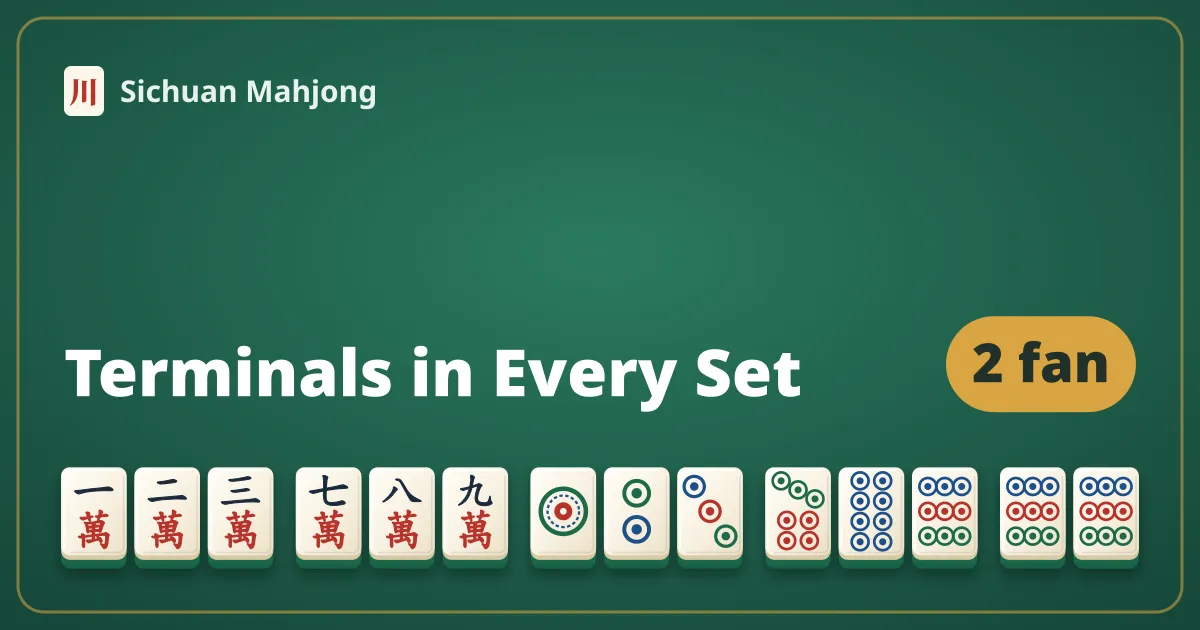
In Sichuan mahjong, terminals in every set (全帶么, quan dai yao) is worth 2 fan — each payer pays 4 units: when you win, all four sets and the pair contain a 1 or a 9. Sichuan mahjong has no honor tiles, so the "terminals" are just the 1s and 9s of characters, dots and bamboo.
On this page
The rules for terminals in every set
- Every set must contain a 1 or 9: runs can only be 1-2-3 or 7-8-9; pungs only 1-1-1 or 9-9-9 (or kongs)
- The pair must be 1s or 9s too: a pair of 5 characters breaks it
- Pungs and kongs are fine — the hand doesn't need to be concealed
- Like every Sichuan win, you can't hold your void suit, so only two suits are available
How terminals in every set waits
Waits for this hand tend to be narrow:
- Edge wait: 1-2 waiting on 3, or 8-9 waiting on 7 — just one tile
- Single wait on a terminal: four sets done, waiting on a 1 or 9 for the pair
- Two pairs: a pair of 1s and a pair of 9s, waiting for either to become a pung
The same hand can score very differently depending on the winning tile: the hand above collects 4 units on 9 dots but only 1 on 6 dots. Look carefully when you get ready, and prefer edge waits and terminal single waits when you have the choice.
How terminals in every set is scored
Fan add up, and each extra fan doubles the payment, up to the cap of 4 fan. The hands below are scored live by the same code the game uses (the self-draw bonus and kong payments come on top).
Won on a discard
| Terminals in every set (全帶么) | 2 fan |
| Total | 2 fan |
|---|---|
| Each payer pays 4 units | |
Units = 2 to the power of fan, up to the cap. Self-draw bonus and kong payments come on top.
Won on a discard
| Terminals in every set (全帶么) | 2 fan |
| Root (根) | 1 fan |
| Total | 3 fan |
|---|---|
| Each payer pays 8 units | |
Units = 2 to the power of fan, up to the cap. Self-draw bonus and kong payments come on top.
Common combinations:
| Combination | Fan | Each payer pays |
|---|---|---|
| Terminals in every set | 2 | 4 units |
| + root | 3 | 8 units |
| + pure one suit | 4 | 16 units |
| + win after a kong + root | 4 | 16 units |
With pure one suit it already reaches the default cap of 4 fan.
How it relates to other hands
- Pure One Suit: 1-2-3s and 7-8-9s of one suit with a terminal pair is pure terminals — straight to the cap.
- Root: two 1-2-3 runs plus a pair of 1s means four 1s in your hand — an automatic root.
- Plain hand: one set without a terminal and it's a plain hand (0 fan); terminals in every set is a plain hand plus 2 fan.
- Seven Pairs: seven pairs never counts (only the four-sets-and-a-pair reading does) — and two suits only have four terminal kinds anyway.
How often it happens
In 40,000 hands of normal computer play, terminals in every set is only 0.034% of all wins — about once every 1,030 hands. The reasons are simple:
- Too few usable tiles: every set needs a 1 or 9, so the 3s to 7s are almost useless
- Narrow waits: mostly edge and single waits, rarely several tiles at once
- The computers don't aim for it; it only appears when it falls into place. Humans who go for it see it more often — and win more slowly
Which hands suit terminals in every set
- Lots of terminals to start: three or more shapes like 1-2, 8-9, 1-1, 9-9.
- Few middle tiles: the fewer 4s, 5s and 6s the better — you won't use them.
- Combine with pure one suit: 1-2-3s, 7-8-9s and a terminal pair in one suit hits the cap — far better than terminals alone.
- Read your wait: winning on one side of a wait can score terminals in every set while the other side is a plain hand.
To try it, open a table of online Sichuan mahjong — the computers play blood battle with you and count the fan for you.
Terminals in every set in other mahjong styles
- Japanese mahjong: the no-honors version is "Junchan", 3 han concealed, 2 han open (Japanese mahjong yaku list)
- Chinese Official (Guobiao): Outside Hand, 4 fan (Guobiao fan list)
FAQ
How many fan is terminals in every set?
In Sichuan mahjong it's worth 2 fan; each payer pays 4 units. With pure one suit it's 4 fan.
Does the pair need a terminal too?
Yes. All four sets and the pair need a 1 or 9; a pair of 5 characters breaks it.
Can terminals in every set be All Pungs?
Not in Sichuan mahjong. After the void only two suits remain, with just four terminal tiles — not enough for four pungs and a pair.
Can you pung with terminals in every set?
Yes. Pungs of 1s and 9s contain terminals, and the hand doesn't need to be concealed.
Related hands
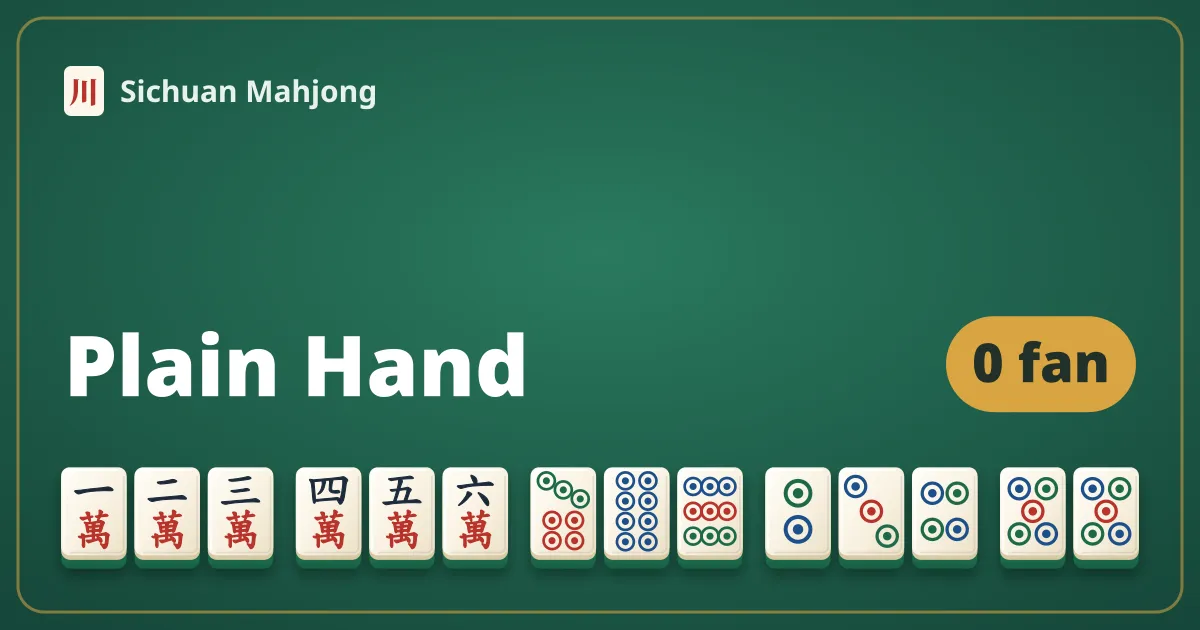 Plain Hand 0 fan
A win with nothing else — the 0-fan basic hand. Examples, pungs allowed, self-draw payments, and how common it is.
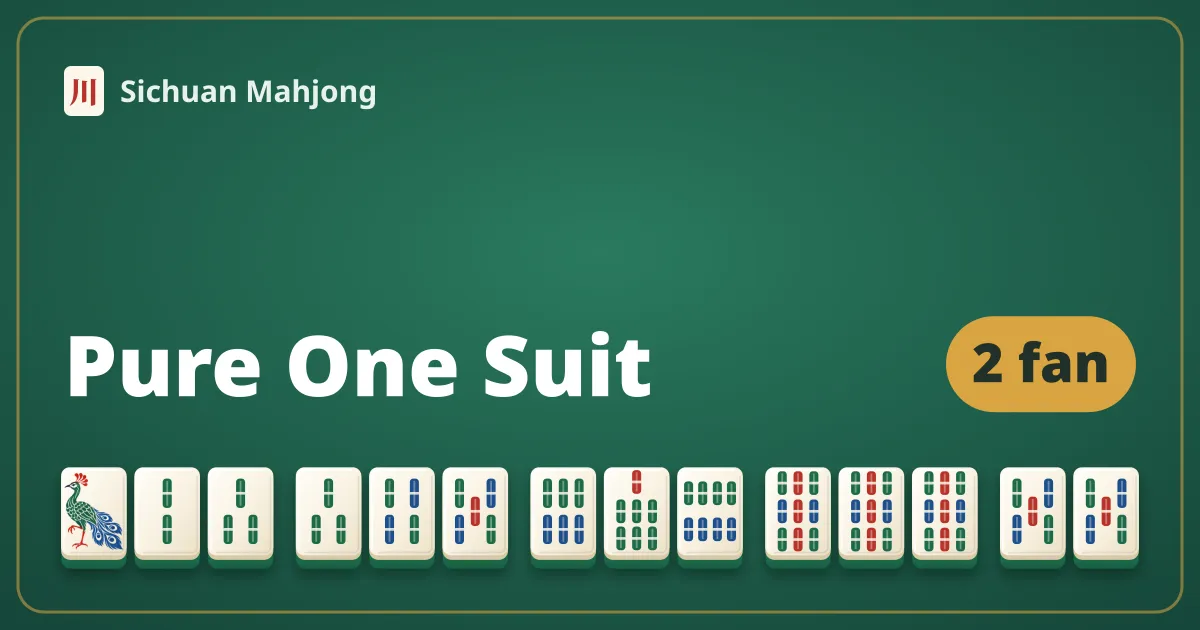 Pure One Suit 2 fan
Every tile from one suit — a 2-fan big hand. Examples, pure pungs / pure seven pairs, and how many tiles of one suit you need to go for it.
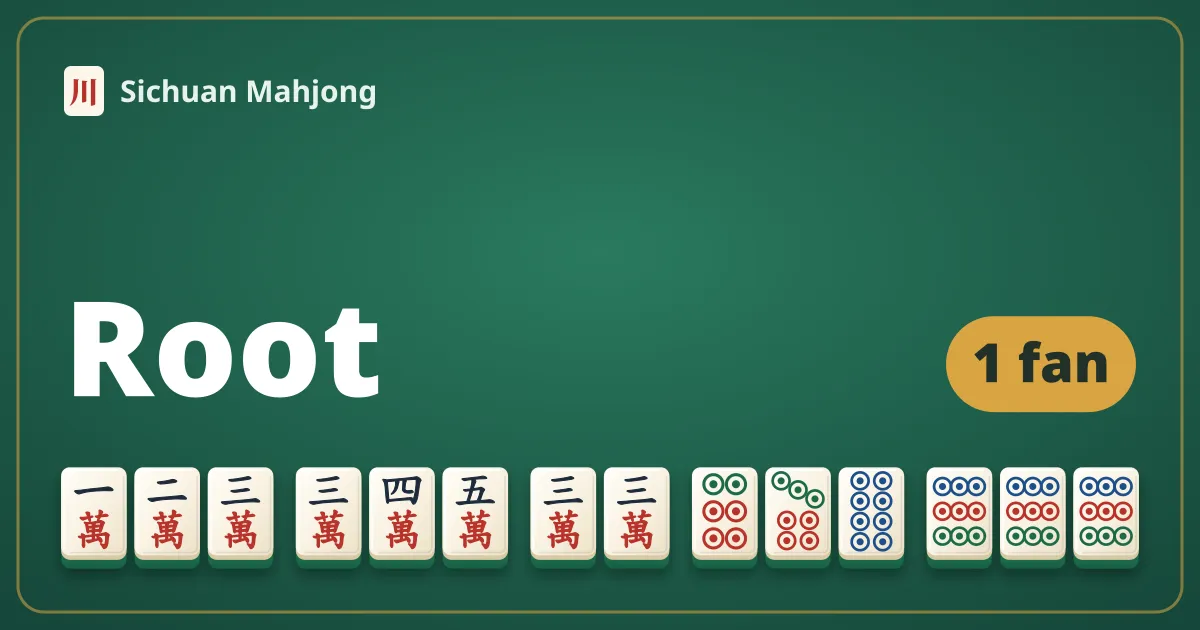 Root 1 fan
All four copies of a tile in your hand adds 1 fan: examples, no kong needed, stacking roots, and how common they are.
Try it at the table
Sichuan Mahjong — Play Sichuan mahjong “blood battle” free in your browser against three computer opponents. 108 tiles, swap three, pick a void suit, pung and kong, and keep playing after someone wins. Automatic fan scoring, no sign-up.